Imagine a customer eagerly opens your package, excited to see their brand-new diamond ring. Yet, they find a bent band and a cracked setting simply because the box was too shallow. For sure, that customer will be very disappointed.
Choosing the right jewelry box is essential for both protection and presentation. The wrong size can easily damage your precious masterpiece, while a perfectly fitting box elevates your brand and keeps the jewelry secure. Most importantly, measuring correctly saves you time, money, and shipping headaches.
So, how to measure jewelry box dimensions? Let’s get into the details!
Standard Jewelry Box Dimensions
The packaging industry uses a strict, industry-standard formula to maintain consistency across manufacturing lines. Always measure and list your specifications in this exact order: Length x Width x Depth (L x W x D).
- Length (L): Look at the open box directly from the front. Measure the longest side from the far-left corner to the far-right corner.
- Width (W): Measure the shorter side of the box, extending from the front panel directly to the back panel.
The standard jewelry box dimensions are:
- Small: 2″ × 2″ × 1.5″ to 4″ × 4″ × 2″ (earrings, rings, small pendants).
- Medium: 4″ × 4″ × 1.5″ to 6″ × 4″ × 2″ (bracelets, watches).
- Large: 7″ × 5″ × 1.5″ to 8″ × 6″ × 2″ (necklaces, jewelry sets).
Note all the numbers you get, and never swap their order. If you accidentally send a packaging manufacturer a “Depth x Length x Width” layout, you will end up with a wildly distorted jewelry box that you cannot use.
Jewelry Box Dimensions Chart
| Standard Jewelry Boxes | Dimensions | Best for |
| Small |
| Earrings, rings, small pendants |
| Medium |
| Bracelets, watches |
| Large |
| Necklaces, jewelry sets |
How to Measure Jewelry Box Dimensions Correctly?
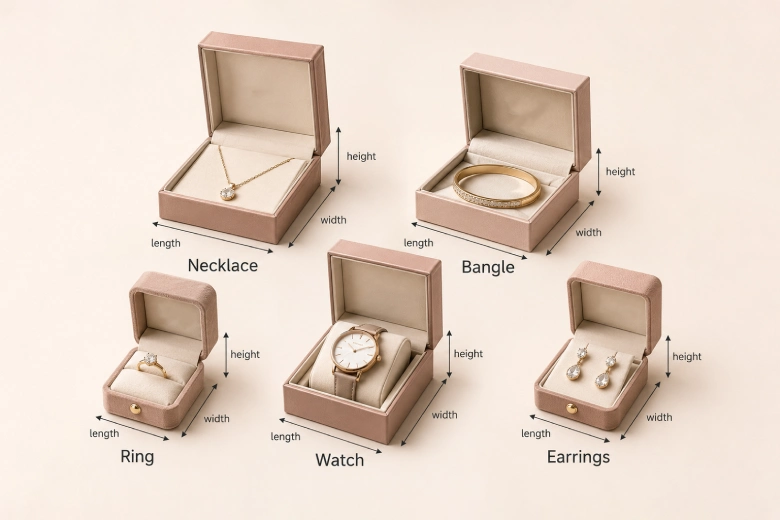
So, how do you find the perfect box for your valuable jewelry?
Follow the steps below.
Measure the Widest Points
Lay your jewelry completely flat. For rings, measure the stone’s diameter and total height. For necklaces, measure the pendant drop or the footprint of the coiled chain.
Account for Extra Hardware
Include the size of clasps, hanging charms, layered chains, or the thickness of watch bands in your final numbers.
Add Clearance for Inserts
EVA foam inserts, velvet cushions, or cotton fills require extra space. Make sure you add 3-5mm of clearance from the box walls so they sit flush.
Note: Always measure the box from its interior dimensions.
Exterior vs Interior Jewelry Box Dimensions
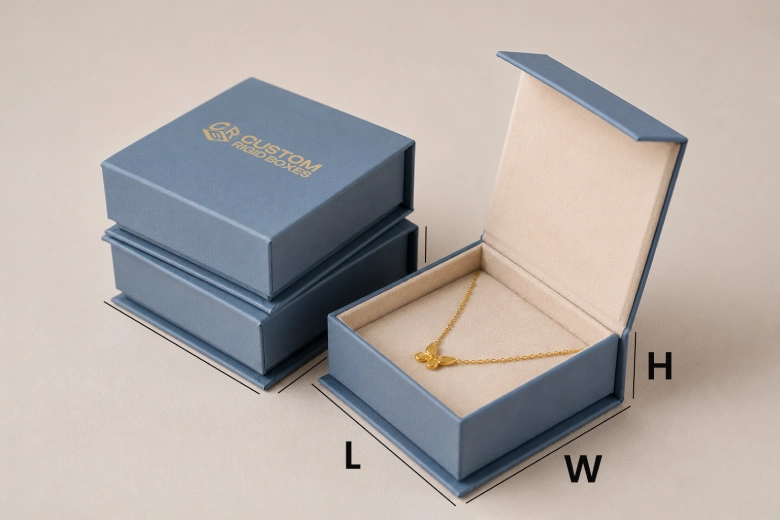
Getting confused about interior and exterior box dimensions?
Here’s the explanation.
Exterior Dimensions of a Jewelry Box
Exterior dimensions indicate the box’s outside dimensions when fully closed. These numbers are essential for calculating shipping costs, as most carriers charge based on the total box volume. Plus, exterior dimensions tell you whether a jewelry box will physically fit on a retail shelf, in a vault, or in a vanity drawer.
How to measure it?
To start, close the jewelry box completely and place a firm ruler along the outermost edges. Do not skip over raised hinges, decorative handles, or protruding outer bows, as these add to the overall footprint.
Measure the maximum length, width, and height from outside wall to outside wall, rounding up to the nearest fraction of an inch for shipping safety.
Interior Dimensions of a Jewelry Box
Interior dimensions measure the actual usable space inside the box that holds your jewelry and protective inserts. Because of the wall thickness and construction layers, the internal space is always smaller than the external size. Measuring this space accurately ensures your jewelry does not pinch or shake around.
How to measure it?
Open the box completely and place your tape measure flat against the inner walls. Measure from inside left wall to inside right wall for Length, and inside front wall to inside back wall for Width. For Depth, measure from the inside floor to the top inner lip.
Always subtract the thickness of any foam pads, velvet liners, or silk pillows, as a thick foam pad can instantly steal 0.5 inches of usable height!
Jewelry Box Dimensions by Jewelry Type
Different jewelry styles require specific box dimensions to ensure safe transit.
Here are the box dimensions to consider by jewelry type.
Rings
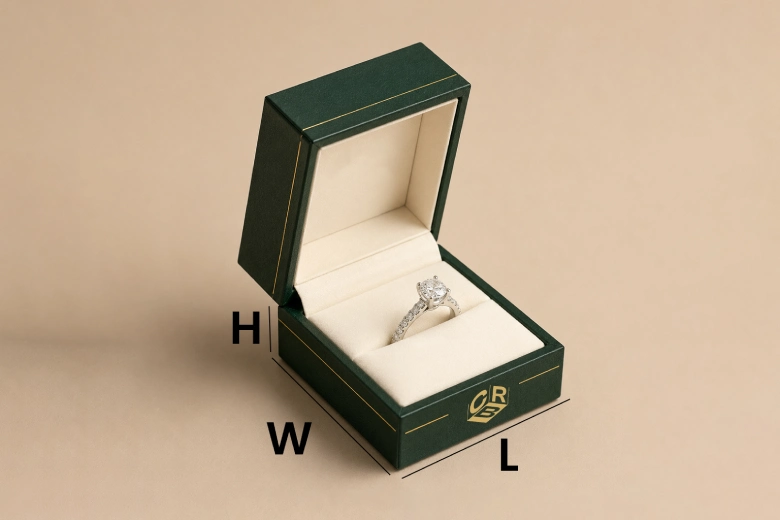
Ring boxes need extra vertical depth to accommodate high-gemstone settings and thick bands without exerting pressure.
- A classic single ring box measures 2″ x 2″ x 1.5″
- Double ring boxes expand the length to 3.5″ x 2″ x 1.5″
Necklaces
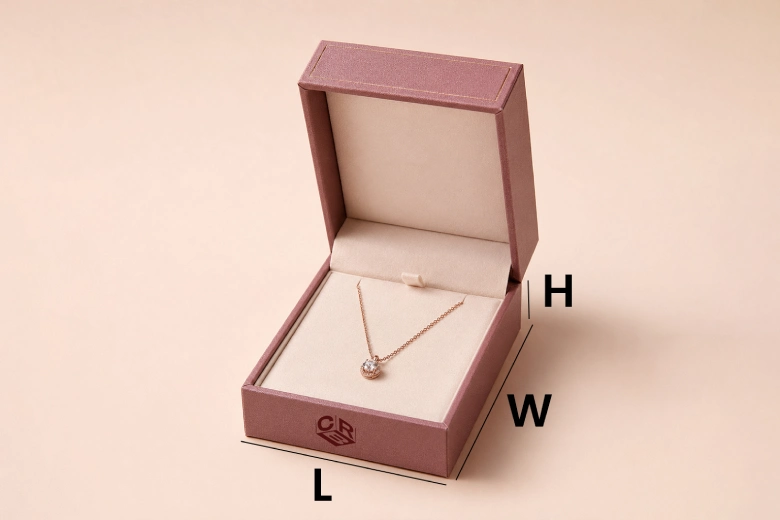
Long necklaces must lie flat or wrap securely around a padded insert to prevent the chain from shifting.
- Standard necklace boxes measure 3.5″ x 3.5″ x 1″
- Longer chain boxes measure 8″ x 2″ x 1″
Bracelets
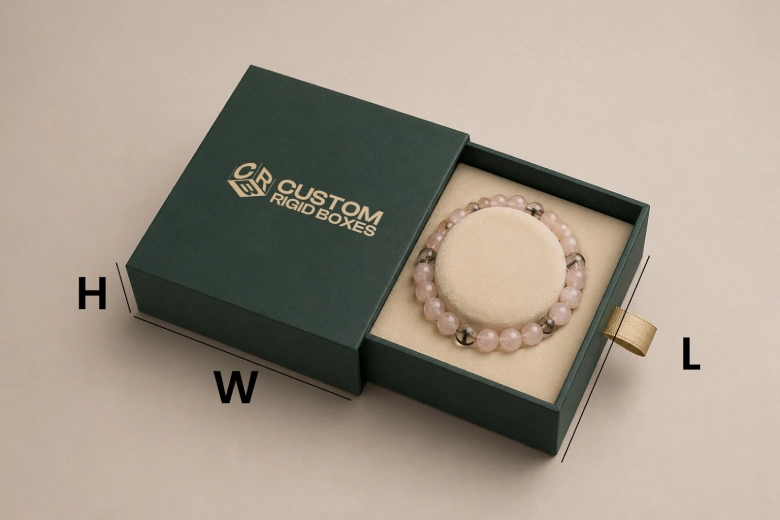
Bracelets can either lie completely flat or wrap around a soft pillow insert, depending on their rigidity.
- Flat bracelet boxes measure 8.5″ x 2″ x 1″
- Square boxes for chunky bangles require deeper dimensions of 4″ x 4″ x 2″
Earrings
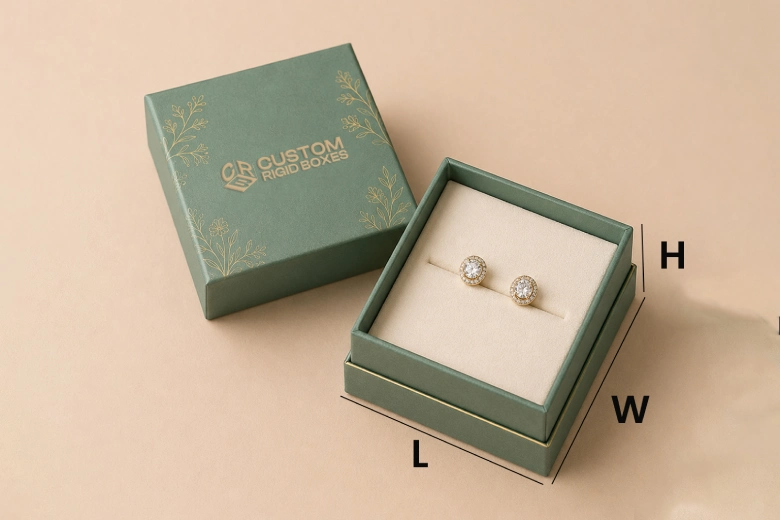
Earring boxes require strategic depth so the delicate metal posts do not bend, snap, or scratch the friction backs.
- Small stud earring boxes measure 2″ x 2″ x 1″
- Large hoop or drop earring boxes expand to 4″ x 4″ x 1.2″
Anklets
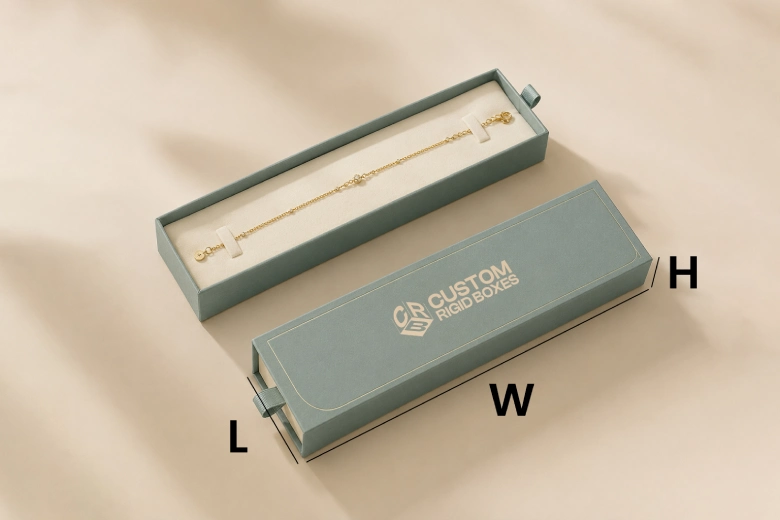
Anklets are similar to bracelets but often feature delicate, dangling charms that can easily snag.
Here are the dimensions you need for anklet boxes:
- Standard flat boxes measure 9″ x 2″ x 1″
- Square styles with custom foam inserts measure 3.5″ x 3.5″ x 1″
Watches
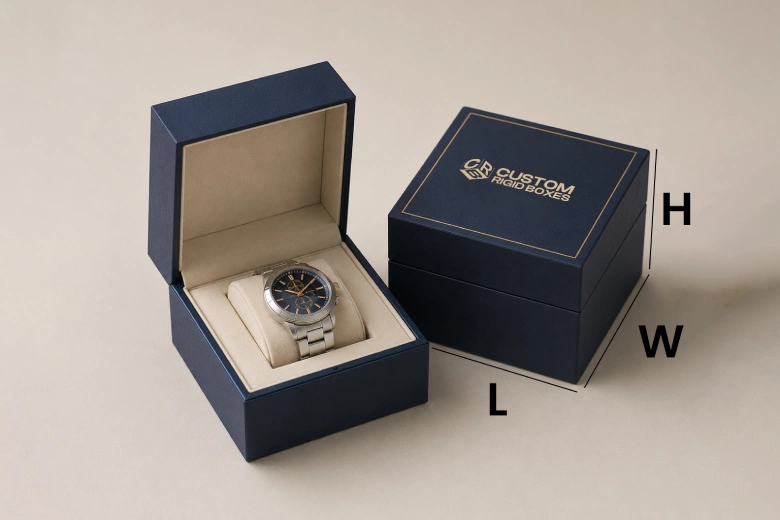
Watch boxes need significant depth because they are stored wrapped around a thick display pillow.
- A standard single watch box measures 4″ x 4″ x 3.25″
The depth must be at least 3 inches to prevent crushing the delicate watch face or scratching the outer bezel against the lid.
Jewelry Sets
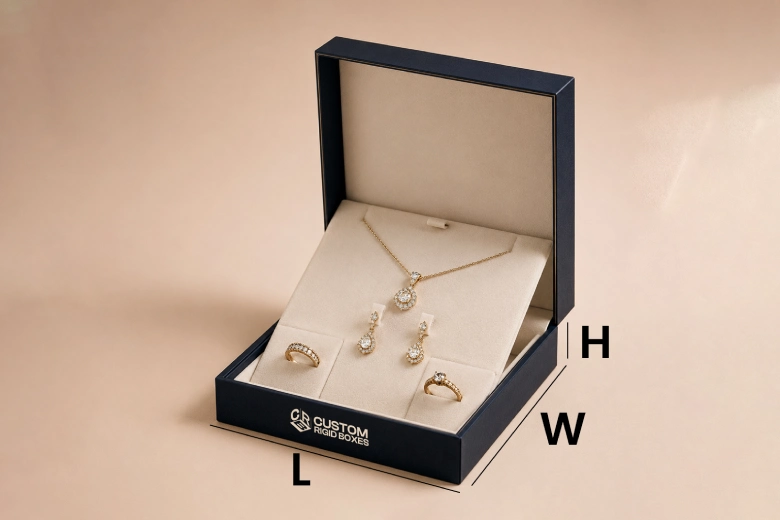
Jewelry sets combine multiple pieces, such as a matching necklace, ring, and earring set, in a single display.
- Large multi-piece set boxes measure 6″ x 6″ x 1.25″
- Extra-large statement set boxes measure 8″ x 6″ x 1.5″
| Jewelry Type | Box Dimensions |
| Ring |
|
| Necklace |
|
| Bracelet |
|
| Earring |
|
| Anklet |
|
| Watch |
|
| Jewelry Set |
|
Jewelry Box Styles: How to Get the Right Dimensions
Jewelry pieces are typically packaged in luxury rigid boxes.
Yet, there are many types of rigid boxes, right? If you are planning to follow some trending jewelry packaging ideas, the box style you choose can change the entire look of your jewelry.
Let’s explore the different box styles with their standard dimensions.
Two Piece Boxes
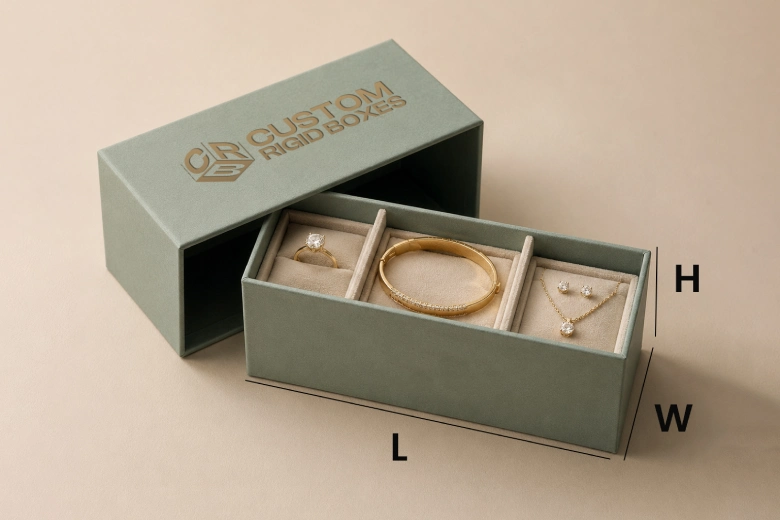
This classic style features a separate base and a completely removable lid that slides over the bottom.
The standard multi-purpose size for this style is 3.5″ x 3.5″ x 1″; perfect for pendants, brochures, and jewelry gifts.
Always measure the inner base piece first to guarantee your jewelry fits safely inside. When measuring the lid for shipping calculations, remember that the lid width will always be slightly larger so it slides over the base smoothly.
Drawer Boxes
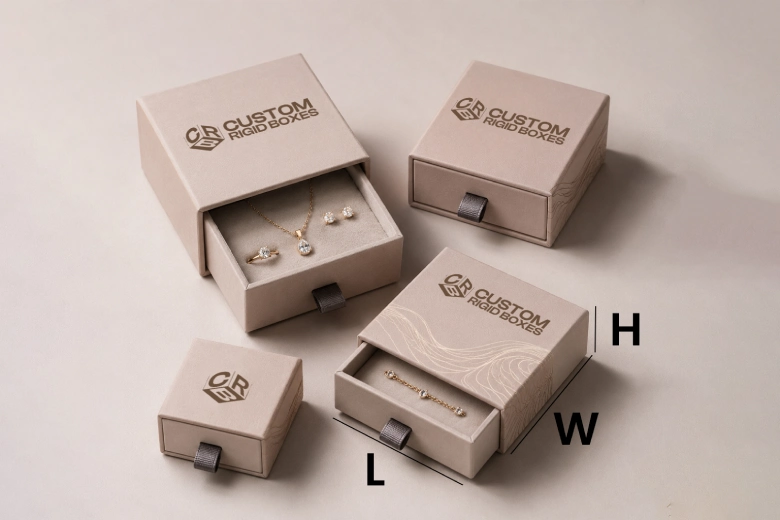
These boxes slide open horizontally using a small ribbon pull, a finger notch, or an elegant cord.
The standard dimension for a drawer-style box is 4″ x 4″ x 1.25″, which accommodates bulkier pieces like bracelets or large studs, watches, and delicate chains.
Measure the internal sliding tray to ensure your jewelry fits within the actual moving compartment. Remember that the outer sleeve adds extra thickness to the width and height. Plus, you must account for the extra 0.25 inches the pull tab adds to the total exterior length.
Magnetic Closure Boxes
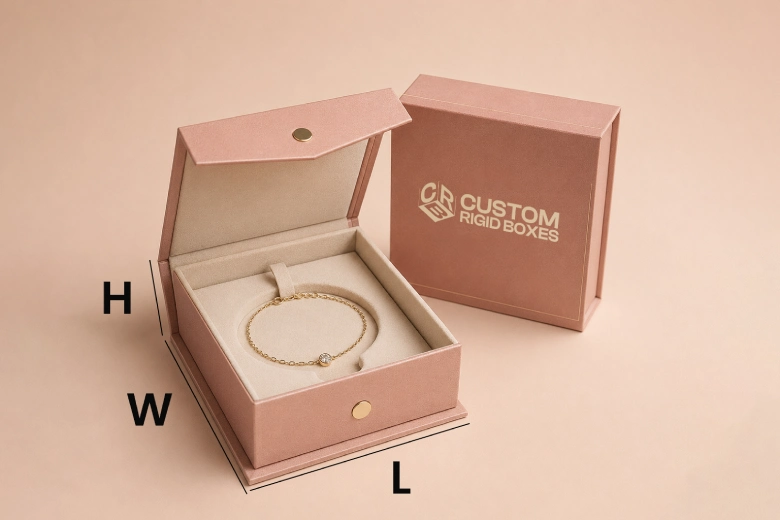
These premium boxes feature a folding lid with hidden magnets that snap firmly shut.
The standard dimension for a magnetic jewelry box is 5″ x 4″ x 1.5″, offering a luxury layout for high-end necklaces or luxury wristwear.
Measure the interior flat bed with the box fully open and lying flat on your counter. Pay close attention to the front flap depth, as the magnetic flap must seal perfectly flat without forcing the front wall down or compressing the jewelry inside.
Shoulder Neck Boxes
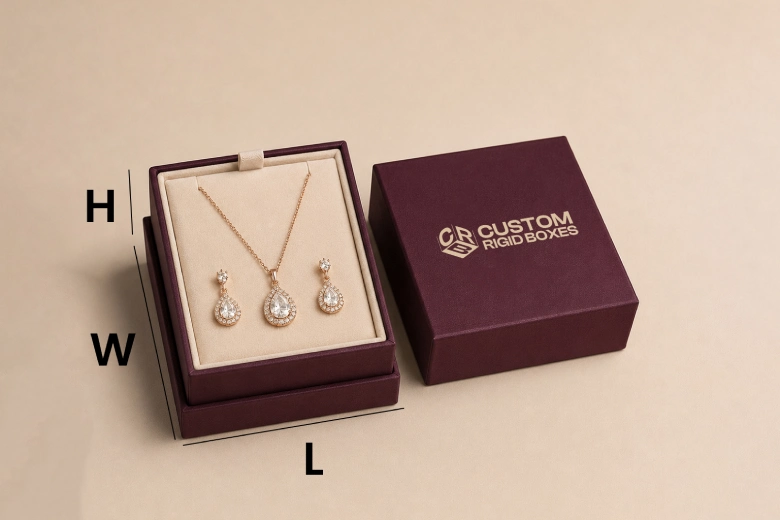
This luxury style creates a visible, elegant gap between the lid and base, showing off a contrasting inner color. The internal “neck” piece extends above the bottom base to hold the lid in place. A shoulder neck box is ideal for engagement rings, limited-edition pieces, and luxury watches.
The standard dimension for a shoulder box is 3.5″ x 3.5″ x 1.5″, ensuring a deep canvas for premium rings, watches, or delicate jewelry sets.
Measure the height of the extended neck separately from the base, and ensure the lid depth matches the neck height for a perfectly flush close.
Round Boxes
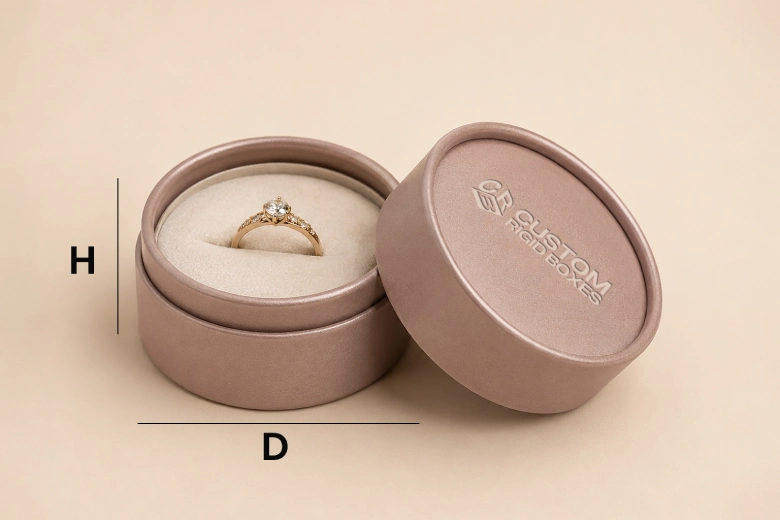
The soft edges of a round box make it perfect for almost all types of jewelry, such as bracelets, bangles, brooches, circular pendant necklaces, and fine jewelry sets.
To measure a round box’s dimensions, you need to calculate:
- Diameter (D): The width across the widest part of the circle, passing through the center.
- Height (H): The vertical distance from the base to the top edge.
So, what standard dimensions can you choose from?
- Small: 3″ to 5″ (D) x 2″ to 4″ (H) for earrings and rings.
- Medium: 6″ to 9″ (D) x 3″ to 6″ (H) for bracelets, watches, and pendants.
- Large: 10″ to 24″+ (D) x 4″ to 18″ (H) for jewelry sets.
| Jewelry Box Style | Dimensions | Best for |
| Two Piece Boxes | 3.5” x 3.5” x 1” | Pendants, brochures, and jewelry gifts |
| Drawer Boxes | 4″ x 4″ x 1.25″ | Bracelets or large studs, watches, and delicate chains |
| Magnetic Closure Boxes | 5″ x 4″ x 1.5″ | High-end necklaces or luxury wristwear |
| Shoulder Neck Boxes | 3.5″ x 3.5″ x 1.5″ | Premium rings, watches, or delicate jewelry sets |
| Round Boxes | 3″ to 5″ (D) x 2″ to 4″ (H) | Earrings and rings |
| 6″ to 9″ (D) x 3″ to 6″ (H) | Bracelets, watches, and pendants | |
| 10″ to 24″+ (D) x 4″ to 18″ (H) | Jewelry sets |
Standard vs Custom Dimensions for Jewelry Boxes
Should you buy ready-made boxes or design your own custom jewelry packaging?
When to Choose Standard Dimensions
Choose standard dimensions if:
- You have a tight budget.
- You are facing a fast deadline.
- You are launching a new jewelry line.
When to Choose Custom Dimensions
Choose custom dimensions if you have unique, high-end, or irregularly shaped jewelry pieces. Custom sizing lets you design a jewelry box around the exact shape of an item, minimizing shifting during shipping. Most importantly, custom dimensions eliminate empty space, reduce the need for ugly bubble wrap, and elevate your brand identity for a memorable unboxing experience.
Why Jewelry Box Dimensions Matter?
Accurate box dimensions protect your financial bottom line just as much as they protect your valuable inventory.
Here’s why jewelry box dimensions matter.
Damage Prevention
A snug fit restricts movement and acts as a shock absorber, preventing your fragile prongs and delicate stones from striking the inner walls.
Tangle Management
Correctly scaled dimensions keep your necklaces straight and prevent chains from knotting.
Shipping Costs
Minimizing box size reduces dimensional weight charges, cutting logistics and shipping overhead.
Customers’ Unboxing Experience
The “sweet spot” fit makes your jewelry look secure and curated, subconsciously communicating value to customers.
Organizational Efficiency
Standardized dimensions make it easier for customers to store your jewelry boxes in vanity drawers, safes, or travel cases.
In Summary
No doubt, choosing the right jewelry box is essential for both protection and presentation. Measuring correctly saves you time, money, and shipping headaches. Always use the Length x Width x Depth format and measure your box dimensions in inches.
Overall, jewelry box dimensions matter for preventing damage, managing space and tangles, reducing shipping costs, improving the customer unboxing experience, and improving organizational efficiency.
FAQs
How to measure jewelry box dimensions?
Measure the widest points of your jewelry, account for extra hardware, and add clearance for custom inserts.
What are standard jewelry box dimensions?
The standard jewelry box dimensions include Small (2″ × 2″ × 1.5″ to 4″ × 4″ × 2″), Medium (4″ × 4″ × 1.5″ to 6″ × 4″ × 2″), and Large (7″ × 5″ × 1.5″ to 8″ × 6″ × 2″).
Why jewelry box dimensions matter?
Jewelry box dimensions matter for preventing damage, managing space and tangles, reducing shipping costs, improving the customer unboxing experience, and improving organizational efficiency.
Are jewelry box dimensions measured from the exterior or interior?
Jewelry box dimensions are measured from the interior, which is the actual usable space inside the box that holds your jewelry and protective inserts.