Whether you are sending a gift, moving houses, or designing custom packaging for your business, getting the box dimensions right is essential. An accurately measured box is the difference between a perfect fit and a shipping nightmare. But wait, isn’t it difficult to measure a box dimensions? Not really.
In this guide, we reveal the steps to measure a box dimensions and why they matter.
Understand the Three Components in Box Dimensions
Before you grab your tape measure, we need to understand the language of logistics: length, width, and height.
In the packaging world, there is a specific standard:lxwxh. This format ensures that manufacturers and couriers understand exactly what you need without expensive errors.
Here is how to identify each accurately:
- Length: The longest side of the box with a flap.
- Width: The shorter side of the box with a flap (the side perpendicular to the length).
- Height: The only vertical measurement. It is often referred to as the “depth” in certain industries, leading to the length-depth-height-width confusion, but for most, “height” is the vertical standing side.
How to Measure a Box Dimensions? Step-by-Step Guide
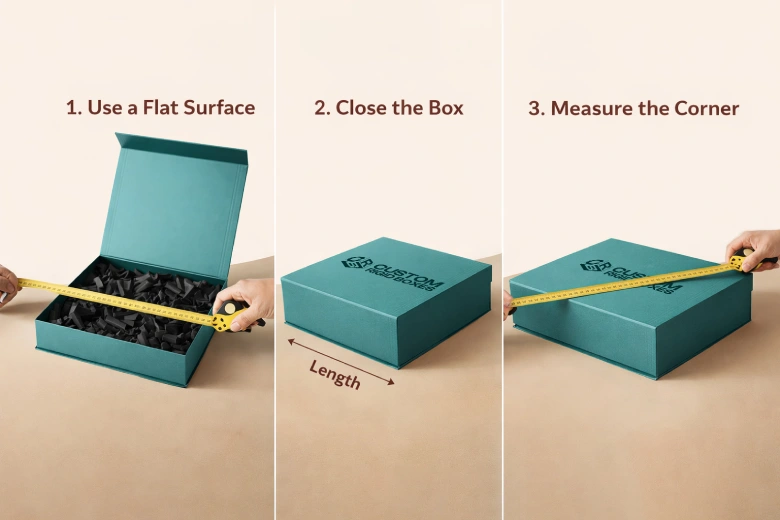
Measuring a box isn’t just about the numbers; it’s about the perspective. To get an accurate length, breadth, and height reading, always place the box in front of you on a flat surface with the opening (flaps) facing up.
Here are the easy steps to follow.
- Place the box on a flat surface so all panels are at 90 degrees.
- Use a tape measure or a ruler to measure the length of the box first (the side with the longest flap).
- Turn the box 90 degrees and measure the width (the side with the shorter flap)
- Measure the height (or depth) of the box, which includes the flaps closed, from top to bottom.
- Note all the numbers you get.
How to Calculate the Volume of a Box?
Volume tells you how much space is inside your box. Why do you need to calculate it? It is essential for determining how much “filler” (like bubble wrap) you will need or how much product can fit inside.
To find the volume, simply multiply the height, width, length. The formula is Length x Width x Height.
For example, if your box measurements are 10″ x 8″ x 5″, your volume is 400 cubic inches.
The Importance of Internal Dimensions
One of the biggest mistakes we might make is failing to differentiate between the inside and the outside of the box.
Internal dimensions ensure your product actually fits. So, when you buy a box, the listed box dimensions are the internal dimensions. This lets you match the size of your product directly to the box size, without worrying about the material thickness.
Do we need bigger inside dimensions of the box?
Yes. You need slightly larger internal length x width space.
Bigger internal dimensions of the box are essential for:
- Padding: Space for foam, tissue, or bubble wrap.
- Product protection: To prevent the box walls from rubbing against and damaging the product’s finish.
- Ease of packing: To ensure you aren’t struggling to force an item into a tight space, which could blow out the seams.
Different Types of Boxes with Different Measuring Techniques
There are many types of packaging materials, so you’ll encounter different box types. In this context, do we need different techniques when measuring them?
Yes. Let’s break it down.
Corrugated Boxes

If you’re using a corrugated box, measure the internal dimensions to ensure product fit.
Make sure you measure from score line to score line. Because corrugated boards have flutes (thicknesses), external measurements are not suitable for the usable space. The standard is: Length x Width x Depth (where depth is the height).
Rigid Boxes
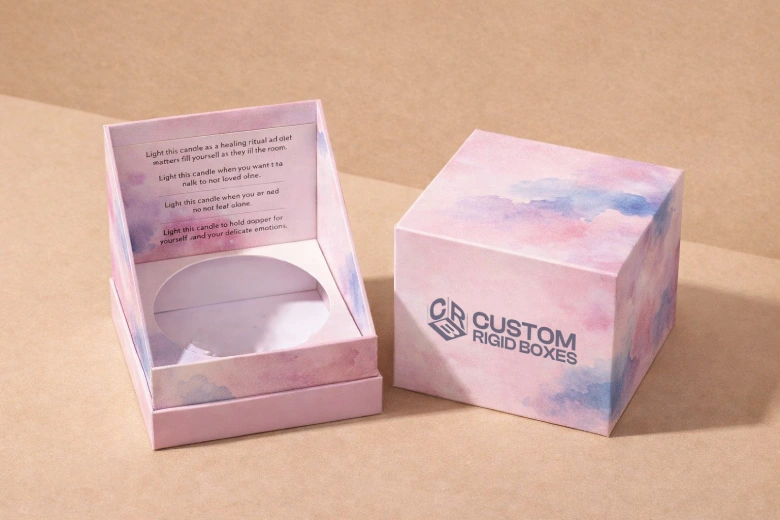
Rigid packaging boxes rarely fold flat. Thus, you need to measure them externally (from the outer dimensions). This way, you can determine how they fit into outer transit packaging or retail displays.
Note: The box’s material thickness (rigid stock) is substantial, making the inner measurements less relevant for overall shipping size.
Folding Cartons

Folding cartons require very precise, often millimeter-accurate. They are usually measured while assembled, but sometimes calculated while flat. Measure the internal dimensions to ensure a tight, secure fit for your product inside.
Measuring a Box Dimensions Based on Its Shape
Not every box is a standard cube. Different shapes require specific width, depth, length approaches to ensure they are handled correctly by shipping sorters.
Well, measuring a box dimensions based on its shape is quite easy, too.
Rectangular Boxes

The most common shape for shipping or mailer boxes. Rectangular boxes follow the standard length, width, height rules perfectly. These boxes are ideal for, and commonly used to package products that are longer in one dimension. Think of apparel boxes or electronics packaging.
How to measure a rectangular box? Measure the longest side (Length), the shorter side (Width), and the vertical distance (Height).
Square Boxes

A square box is a cube with all sides equal. It is perfect for packing, shipping, and displaying uniform, cubic, or balanced products.
Examples? Watch boxes and jewelry boxes are mostly square.
How to measure a square box? Since all sides are equal, simply measure one side for length x width, and the vertical for height (you’ll get the same numbers).
Round Boxes
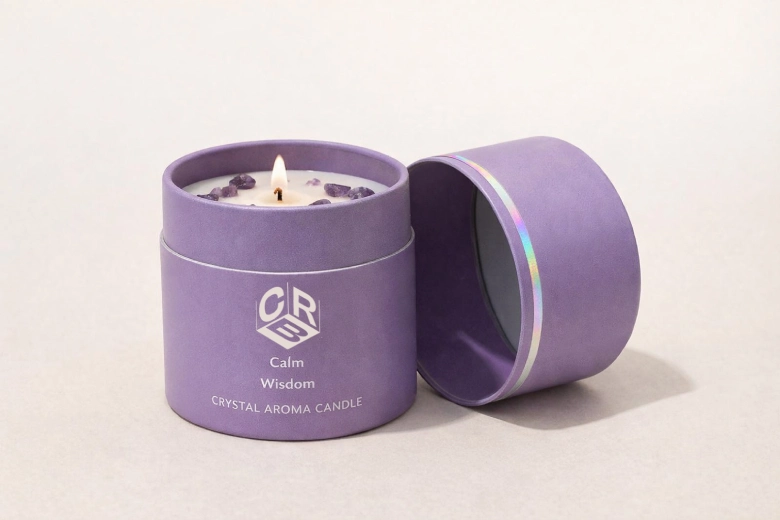
Round boxes don’t have a traditional lxwxh format. Why? These boxes feature a cylindrical shape with a separate base and a slightly larger lid that fits snugly over the base.
They are great for premium, fragile, or cylindrical products. For example, you might have seen many cosmetic packaging or luxury candle boxes in a round shape.
How to measure a round box? Treat the circular diameter as both the Length and Width. Then, measure the tube from top to bottom for the Height.
Hexagonal Boxes

Yes, hexagonal boxes. As the name suggests, they have six sides
The unique shape makes the boxes popular for specialty retail, exclusive chocolate boxes, or high-end gift packaging.
How to measure a hexagon box? Measure from the widest point (point to point) for the Length, and the distance between flat sides for the Width. The Height remains the vertical distance.
Triangular Boxes

Triangular boxes are commonly used for shipping long, thin products to prevent rolling.
How to measure a triangular box? Measure the base of the triangle (Length), the “altitude” or thickness of the triangle (Width), and the total vertical distance of the tube (Height).
Why Box Dimensions Matter?
If you’re having this question in mind, the answer lies in accuracy. Accuracy is the foundation of your shipping and storage efficiency.
Accurate box dimensions are far more than just measurements. In an industry where “measuring once” can lead to thousands of dollars in hidden costs, precision is essential.
Here’s why box dimensions matter.
Lower Shipping Fees
Whether UPS, FedEx, or USPS, these carriers use Dimensional Weight (DIM weight) to calculate costs.
This means that if your box is unnecessarily large, you are charged for the space it occupies rather than just its physical weight. Even a half-inch error along a single axis can increase shipping costs by up to 3% and corrugated material usage by 10%.
Product Safety
Accurate dimensions determine how safely your product arrives. A well-sized box minimizes internal movement. On the other hand, excessive space can cause your product to shift, increasing the risk of damage and potential breakage.
Accurate sizing ensures that your boxes can be stacked effectively without collapsing. As a result, right-sizing protects your products from crushing during handling and storage.
Operational Efficiency
In a warehouse setting, box dimensions drive every automated and manual process. Inaccurate data leads to your products not fitting into their assigned storage, causing some hassles for employees and automated vehicles.
In addition, right-sizing can increase the number of boxes you can load on a single truck, reducing the total number of trips needed.
Brand Reputation and Sustainability
Customers and the environment both benefit from accurate box dimensions. How?
Receiving a small product in a massive box filled with excessive “void fill” (like bubble wrap) creates a poor brand impression and “wrap rage” for customers. This will surely make your brand look unprofessional to them.
And speaking of environmental impact, accurate measurements ensure no packaging material is wasted.
Summing Up
No doubt, an accurately measured box is the difference between a perfect fit and a shipping nightmare. To measure a box dimensions, place the box on a flat surface, measure the length, turn the box 90 degrees to measure the width, measure the height (or depth) of the box, and note all the numbers you get.
Accurate box dimensions matter for lower shipping fees, product safety, operational & warehouse efficiency, and brand reputation & sustainability.
Nevertheless, make sure you measure your box dimensions accurately!
FAQs
What are the three components in a box dimensions?
The three components in a box dimensions include: Length (the longest side of the box with a flap), Width (the shorter side of the box with a flap), and Height (the vertical measurement).
How to measure a box dimensions?
To measure a box dimensions, place the box on a flat surface, measure the length, turn the box 90 degrees to measure the width, measure the height (or depth) of the box, and note all the numbers you get.
Do we need bigger inside dimensions of the box?
Yes, bigger internal dimensions of the box are essential for protective padding, product protection, and ease of packing.
Why do box dimensions matter?
Accurate box dimensions matter for lower shipping fees, product safety, operational & warehouse efficiency, and brand reputation & sustainability.